Tap Water: Solution, Suspension, or Colloid? The Reveal
Determining what type of mixture is tapwater best classified as often involves analyzing its composition using techniques common in environmental chemistry. Tap water itself, supplied by municipal water treatment facilities, contains dissolved minerals and sometimes trace amounts of sediment. The Environmental Protection Agency (EPA) sets standards for these components. Therefore, understanding tap water’s classification requires considering factors that affect its homogeneity and stability, key aspects scientists at organizations like the *EPA* constantly assess through rigorous analytical methods.
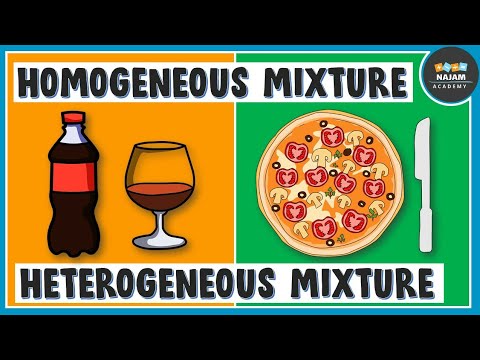
Image taken from the YouTube channel Najam Academy , from the video titled Homogeneous and Heterogeneous Mixture | Chemistry .
Tap Water: Solution, Suspension, or Colloid? The Reveal
The question of what type of mixture is tap water best classified as is a common point of curiosity. To answer this definitively, we need to understand the different types of mixtures and then analyze the composition of tap water.
Understanding Mixtures
A mixture is a substance comprising two or more components that are physically combined but not chemically bonded. Mixtures can be categorized based on the size of the particles they contain and how those particles are dispersed throughout the mixture. The three main categories we’ll consider are solutions, suspensions, and colloids.
Solutions
- Definition: A solution is a homogeneous mixture where one substance (the solute) is dissolved completely into another substance (the solvent). This means the solute particles are evenly distributed and are so small that they are not visible.
- Key Characteristics:
- Homogeneous (uniform composition throughout).
- Solute particles are very small (typically less than 1 nanometer).
- Does not scatter light (clear).
- Solute will not settle out over time.
- Cannot be separated by filtration.
Suspensions
- Definition: A suspension is a heterogeneous mixture containing solid particles that are large enough to be visible and will eventually settle out.
- Key Characteristics:
- Heterogeneous (non-uniform composition).
- Particles are relatively large (typically greater than 1000 nanometers).
- Scatters light (cloudy or opaque).
- Particles will settle out upon standing.
- Can be separated by filtration.
Colloids
- Definition: A colloid is a mixture with properties intermediate between a solution and a suspension. Its particles are larger than those in a solution but smaller than those in a suspension. They remain dispersed but do not fully dissolve.
- Key Characteristics:
- Appear homogeneous to the naked eye but are heterogeneous under magnification.
- Particle size ranges from 1 to 1000 nanometers.
- Scatters light (Tyndall effect).
- Particles do not settle out quickly.
- May or may not be separable by filtration, depending on the filter pore size.
Analyzing Tap Water Composition
Tap water isn’t pure H₂O. It contains dissolved minerals and sometimes added substances like fluoride and chlorine for health and sanitation purposes. The specific composition varies depending on the source of the water and the treatment processes used.
Common Components
- Water (H₂O): The primary solvent.
- Minerals: Typically includes calcium, magnesium, sodium, and potassium ions, among others.
- Fluoride: Often added to promote dental health.
- Chlorine/Chloramine: Used as disinfectants to kill harmful bacteria and viruses.
- Trace Amounts of Other Substances: May include organic matter, dissolved gases, and very small particulate matter.
Classifying Tap Water
Given its composition, tap water exhibits properties that align most closely with a solution, but with possible colloidal aspects dependent on specific conditions.
-
Dissolved Minerals: Minerals are dissolved at an atomic or molecular level, becoming ions within the water. This is characteristic of a solution. They are evenly distributed and don’t settle out.
-
Homogeneity: Tap water typically appears clear and uniform throughout. It is, for the most part, homogeneous.
-
Light Scattering: While generally clear, tap water can sometimes exhibit a slight scattering of light if it contains small amounts of colloidal matter (e.g., some types of organic matter). However, this scattering is usually minimal.
-
Filtration: Standard water filters remove some larger particulate matter, improving water quality. However, the dissolved minerals and additives remain, and only specialized filtration methods like reverse osmosis can effectively remove these dissolved components. This reflects its nature as mainly a solution and only partly as a mixture that could include colloidal material.
Why Not a Suspension?
Tap water is not a suspension because:
- The particles are not large enough to be visible to the naked eye.
- The particles do not settle out upon standing (except for some very rare cases with extreme sediment).
Possible Colloidal Aspects
It’s important to acknowledge that, depending on the source and treatment of tap water, it can exhibit some colloidal properties. This is particularly true if the water contains:
- Very small amounts of organic matter.
- Certain metal oxides.
These substances can form particles in the colloidal size range. However, these are usually present in very low concentrations and do not significantly change the overall classification.
Therefore, while trace amounts of colloidal matter might be present, tap water is best classified as a solution. The dissolved minerals and other additives are dispersed at a molecular level, making it a homogeneous mixture. The small amount of possible colloidal material does not change the overall classification of tapwater as a solution.
Tap Water: Understanding Its True Nature – FAQs
Here are some frequently asked questions about tap water and its classification as a mixture. This will help clarify what type of mixture is tap water best classified as.
What exactly is the difference between a solution, suspension, and colloid?
A solution is a homogeneous mixture where one substance dissolves completely into another (like sugar in water). A suspension has larger particles that are visible and will settle out over time (like sand in water). A colloid has particles larger than those in a solution but smaller than those in a suspension, and they remain dispersed.
What type of mixture is tap water considered, and why?
Tap water is best classified as a solution. Although it can contain some undissolved particles, these are typically very small and are often filtered out during treatment. The dissolved minerals and chemicals present are uniformly distributed.
Are the dissolved minerals in tap water visible to the naked eye?
No, the dissolved minerals in tap water are not visible to the naked eye. They are present as individual ions or molecules, which are far too small to be seen without magnification. This contributes to what type of mixture is tap water best classified as.
If tap water contains undissolved particles, doesn’t that make it a suspension or colloid?
While tap water may contain some tiny, undissolved particles, they are usually present in very low concentrations and are kept dispersed. The dominant characteristic of tap water is the presence of dissolved substances, thus what type of mixture is tap water best classified as a solution. Suspensions and colloids have a significantly higher concentration of visible, undissolved particles.
So there you have it! Hopefully, you now have a clearer understanding of what type of mixture is tapwater best classified as. Go forth and impress your friends with your newfound knowledge about solutions, suspensions, and colloids!
